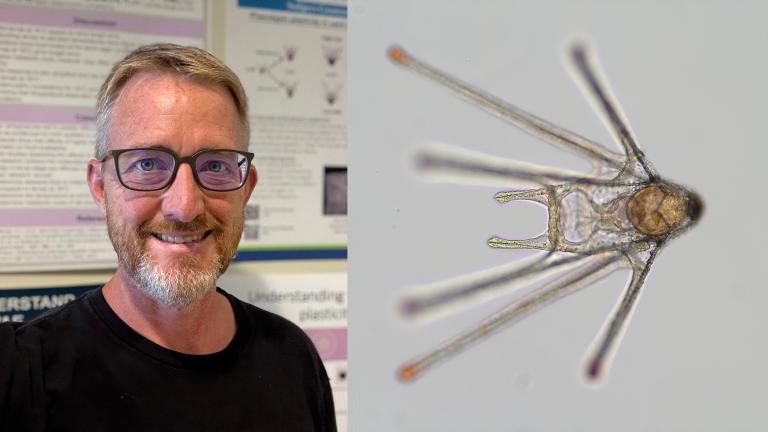
Making Sense of the Arms Race: Phenotypic Plasticity During Sand Dollar Larval Development
by Dr. Douglas A. Pace, California State University, Long Beach
Phenotypic plasticity is a critical response mechanism that allows an organism to express a multitude of phenotypes based on interactions with its environment. This capacity allows organisms to make changes to their biology when environmental conditions change. Feeding larvae of echinoids (sea urchins and sand dollars) exhibit food-induced morphological plasticity in arm length. If food is scarce, larvae grow long arms to increase algal food capture rate. If food is abundant, larvae grow shorter arms and direct energy toward faster development. Studies from our lab at CSULB on larvae of the Pacific sand dollar (Dendraster excentricus) have discovered that these morphological changes are accompanied by significant differences in physiological growth efficiencies.
Dr. Doug Pace grew up in rural New Jersey and developed a fascination for nature. In 1994 he completed a Bachelor of Science in Marine Biology at Long Island University, Southampton College. In 1995 he started his PhD at the University of Southern California where he studied how environmental conditions (food availability, temperature, hydrostatic pressure) affect protein metabolism in developing marine invertebrates. During his studies he conducted research in Antarctica (McMurdo Research Station) and at the hydrothermal vents of the East Pacific Rise. In 2013 he joined the Biology Department at California State University Long Beach
(CSULB) as an Assistant Professor. At CSULB he supervises a lab that studies the developmental physiology of marine invertebrates.
Tickets are available HERE.
Parking is $1 per hour, but FREE for members - become a member today!